edit post
Industry 4.0
How USL Achieved a 4x Return on Investment by Adopting Industry 4.0
Monday, May 18, 2026

Industry 4.0
May 18, 2026
Maria Fernanda de Julio
Do you know how it’s possible to adopt new technologies in Industry 4.0 even without a lot of money to invest? This is extremely important for companies, because modernization isn’t just a desire—it’s a pressing necessity these days.
This is especially true at processing plants, particularly sugar and ethanol mills, where there is a high demand for operational efficiency and a constant focus on keeping assets available for as long as possible. This is because the industry only operates during the harvest season, and any interruption has negative consequences that go beyond maintenance, directly affecting productivity and profitability.
For this reason, Usina Santa Lúcia (USL), one of the largest sugar and ethanol producers in the city of Araras, São Paulo, has been our client since 2022 and has invested in Industry 4.0 to improve its asset management performance.
Their strategy, in turn, was to implement low-cost solutions, such as our vibration sensors, to monitor their assets more efficiently and perform proactive maintenance, just as the São João Plant did.
To motivate you and encourage your company to follow this path, we’d like to share a few examples—among many others—that occurred during the 2023 harvest and resulted in a return four times the initial investment. Shall we get started?
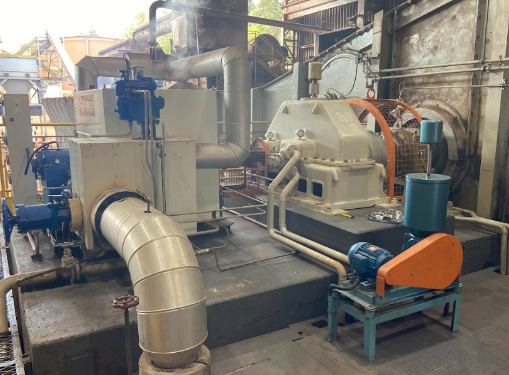
In a sugar mill setting, a shredder is a piece of equipment widely used in the processing of sugarcane for the production of sugar and ethanol.
It is a key component in the production process, as it is responsible for breaking down the fibers of the sugarcane, thereby aiding in the extraction of the juice, prior to the stage known as milling.
As such, it plays a crucial role in the preparation of raw materials in the sugar and ethanol industry, helping to optimize the production of sugar and ethanol from sugarcane.
In the case of USL, monitoring the defibrator made it easier to track rotor imbalance, thereby reducing the number of hammer replacements during the harvest season.
Compared to previous harvests, it was only in 2023 that USL began to use the monitoring system regularly and pay closer attention to the alarms it generated, thereby enabling more effective decision-making. This change, in turn, resulted in fewer replacements of this component—which had previously been 6 but was reduced to just 3—generating a total cost savings of 270,000 during the harvest.
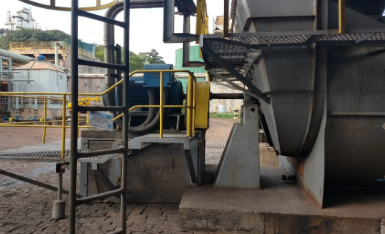
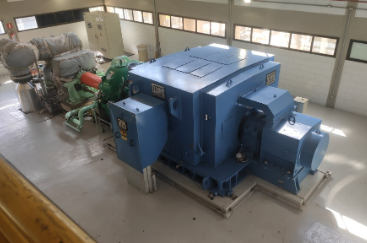
Now let’s talk about two pieces of equipment that are also widely used at the power plant: the exhaust fan and the turbogenerator.
The exhaust fan is a piece of equipment designed to circulate air and remove gases or vapors from the boiler. As an integral part of the boiler system, its operational reliability is critical, since it generates steam for the entire industrial process; therefore, if it stops working, the entire plant could also come to a halt.
And by monitoring vibration conditions from the beginning to the end of the harvest season, it ensured that no intervention was necessary during the off-season, allowing the equipment to be put into storage due to the seasonal nature of production.
A certain food production plant relies heavily on the reliability of its equipment to maintain continuous, high-quality productivity.
As part of its production process, the company operates an automated production line for packaging food in containers. The main equipment on this line includes a filling machine, a packaging sealer, and a conveyor belt.
Let’s take a look at the importance of reliability at every stage of the process:
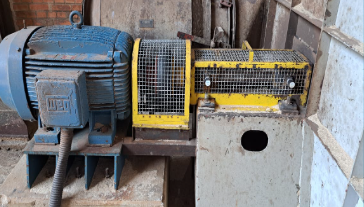
Another piece of equipment that was monitored was the primary fan, which is part of the boiler. While the exhaust fan is used to remove gases from the boiler, the fan is used to supply air to the boiler.
In the case of this asset at USL, a bearing defect in the LOA bearing was identified through data analysis; online monitoring of acceleration and temperature vibration parameters made it possible to postpone the intervention until the off-season.
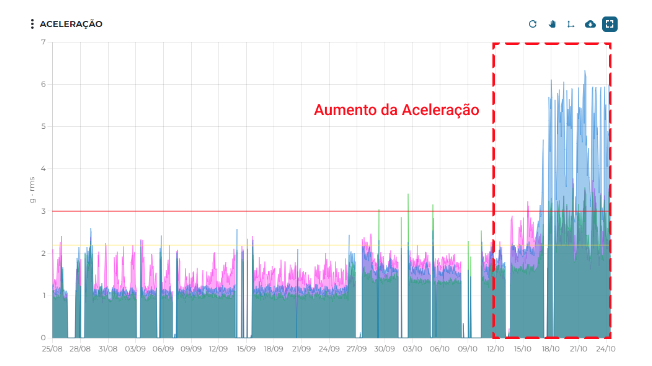
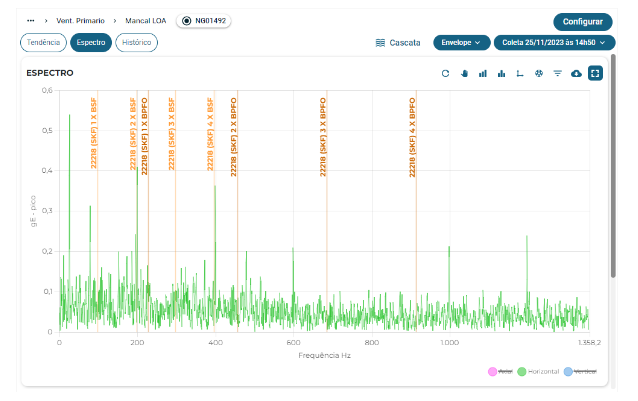
And as we mentioned earlier, at mills that operate on a crop-by-crop basis, such as the Santa Lúcia Mill, any shutdown—even a planned one—directly affects production capacity.
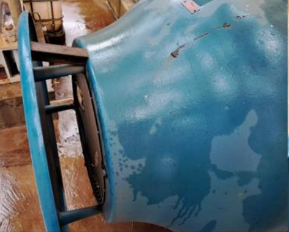
Last but not least, let’s talk about the electric pump, a piece of equipment that combines an electric motor and a hydraulic pump. In general terms, its main function is to move fluids such as water and perform essential tasks in sugarcane processing.
And thanks to our precise and reliable vibration sensors, we were able to identify a gap in the rear cover and extend maintenance work on this equipment into the off-season, thanks to the reliability of the online monitoring and alarms that our IoTebe platform can trigger.
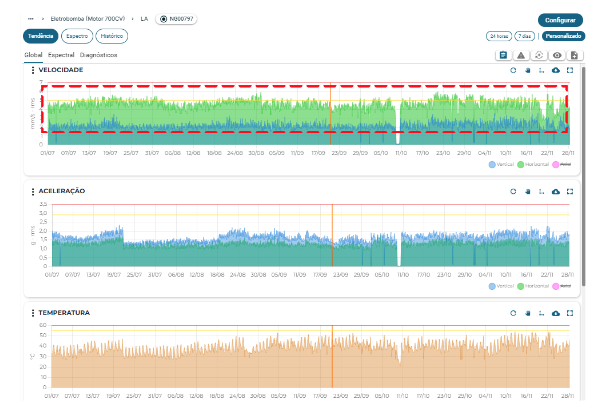
With an effective asset management and resource conservation process in place, USL recognized the importance of monitoring its equipment and increased the number of sensors installed for the 2024 harvest, in order to track more assets and achieve even more significant results.
Another point worth noting is that online monitoring during the 2023 harvest led to the optimization of certain processes, in addition to improving overall reliability and availability for maintenance.
And we believe that our results in 2024 could be even better, thanks to increased use of our IoTebe platform.
Monday, May 18, 2026

Monday, May 11, 2026
Monday, May 11, 2026