
May 11, 2026
Maria Fernanda de Julio
Machines have a lot of information to convey to us, but can you understand what they’re trying to communicate?
That may be true, but without a communication tool to help, there will be a lack of precision, and the process will take longer.
In certain industries, such as sugar and ethanol mills, it is a major challenge when a machine requires unexpected repairs. This results in high costs due to production stoppages, which can lead to reduced output or even shutdown of the machine until the problem is resolved.
In this case, time is money. That is why it is important to have accurate information to know when is the right time to perform maintenance on an asset. Lacking this accuracy can hinder the operational efficiency of the industry.
Keep reading to learn about the importance of vibration monitoring in your industry.
To explain more clearly what vibration monitoring, let’s compare it to the blood pressure measurement taken in humans.
Using a device called a sphygmomanometer—commonly known as a “blood pressure monitor”—it is possible to assess cardiovascular health and diagnose conditions such as high blood pressure.
Following the same line of reasoning, this is what happens with the process of vibration monitoring, used to monitor and assess the health of industrial assets, such as electric motors, centrifugal pumps, compressors, and other rotating devices.
These vibration sensors are installed in strategic locations on equipment to measure the vibrations generated during operation. The data is collected, processed, and analyzed by specialized software, such as IoTebe.
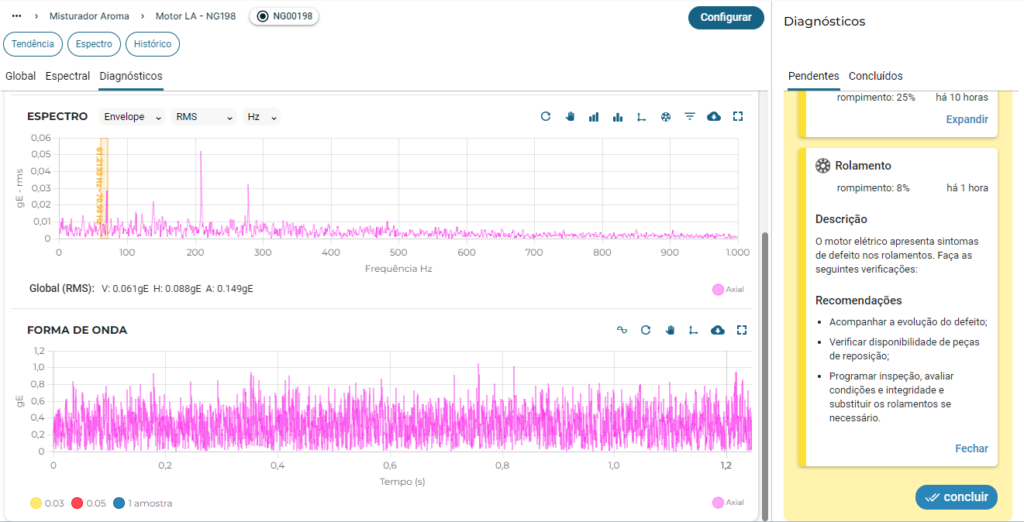
Using these, it is possible to identify abnormal patterns or trends in vibrations, detecting the presence of potential problems, such as misalignments, imbalances, and play.
Based on the information provided by vibration monitoring, operators and their supervisors can plan actions to resolve issues before they escalate.
In general, we can see so far that vibration monitoring is an important and valuable tool for ensuring operations that are:
Now let’s move on to the next topic to understand how vibration monitoring works in power plants and why it’s important. At the end of this article, we have a special invitation for you!
Vibration monitoring plays a key role in sugar and ethanol industries due to complex and equipment-intensive nature of these operations.
Let’s consider a practical example of vibration measurement in the sugar and ethanol industry to better understand this:
A maintenance technician at a sugar and ethanol plant continuously monitors and tracks the vibrations of the defibrator, which is essential equipment for the process of preparing and extracting sugarcane juice.
One day, the online monitoring system identified and alerted, using intelligent algorithms, a defect in the bearing on the internal raceway of that component.
Recognizing the urgency of the problem and coordinating with the production process, the technician took advantage of a rain-induced downtime to examine the issue more closely, at which point he confirmed that the diagnosis was accurate. The crack was indeed present in the bearing.

Based on this information, he confirmed with the warehouse that a spare bearing was available and was able to plan the bearing replacement in advance, resulting in greater efficiency, reduced risk of accidents and stress, and ensuring that there was no loss of productivity for the plant.
This anomaly will be logged in the system and will assist with maintenance management for future monitoring and trend analysis.
The example cited illustrates how vibration measurement in the sugar and ethanol industry is an essential practice and investment for ensuring the reliable operation of equipment. By identifying these problems early on, technicians can take proactive measures to prevent unexpected failures and unplanned downtime, thereby ensuring production continuity and operational efficiency of the industrial plant.
In addition, we have listed below some of the reasons why vibration monitoring is so important, both in sugar and ethanol mills and in other industries:
Continuous vibration monitoring helps ensure the reliable operation of critical equipment in the sugar and ethanol industries. By proactively detecting and correcting issues, companies can avoid unplanned downtime, minimize the risk of more serious failures, and keep production running smoothly.
By using vibration data to schedule maintenance interventions, companies can optimize their maintenance programs. This means that maintenance resources can be allocated more effectively, with interventions performed only when necessary, thereby reducing operating costs.
Equipment with excessive vibration issues can pose a threat to employee safety and increase the risk of equipment damage. Vibration monitoring enables the early detection of these problems, ensuring a safer work environment.
By preventing premature wear and damage to equipment, sugar and ethanol producers can extend the useful life of their assets. This results in a better return on investment in equipment and lower replacement costs.
In many industries, including the sugar and ethanol industry, there are specific occupational safety and health regulations that require the monitoring and control of vibrations in certain types of equipment. Vibration monitoring helps companies comply with these regulations and avoid potential penalties.
In other words, the vibration monitoring is essential to ensure operational efficiency, safety and reliability of equipment in the sugar and ethanol industries. It plays a key role in the implementation of predictive maintenance strategies, cost reduction and maximizing the useful life of assets.