The sugar and ethanol industry plays a crucial role in the Brazilian economy, driving the production of sugar, ethanol, and bioenergy. In an increasingly competitive market, mills are constantly seeking to optimize their processes to boost efficiency and profitability. In this context, maintenance emerges as a strategic factor that can directly influence mills’ production, costs, and revenue.
A sugar and ethanol plant has many assets classified as Criticality A, which by definition are those pieces of equipment essential to the production process and that pose a high safety risk or financial impact in the event of a failure; these are generally the equipment belonging to the following sectors:
- Grinder or Diffuser
- Boilers
- Power Generation
These assets are expensive, costing as much as several tens of millions of reais, which ultimately makes it impractical to implement strategies for maintaining backup equipment to replace them in the event of a failure.
Therefore, it is essential that the equipment be highly reliable and that there be no unexpected breakdowns during the harvest season.
The mill’s harvest season is another important factor to consider in this study. Generally speaking, a mill in Brazil’s Central-South region has a harvest season of approximately 8 months, typically beginning in April and ending in November. The harvest season is determined by climatic and natural factors related to the sugarcane plant, as well as logistical considerations.
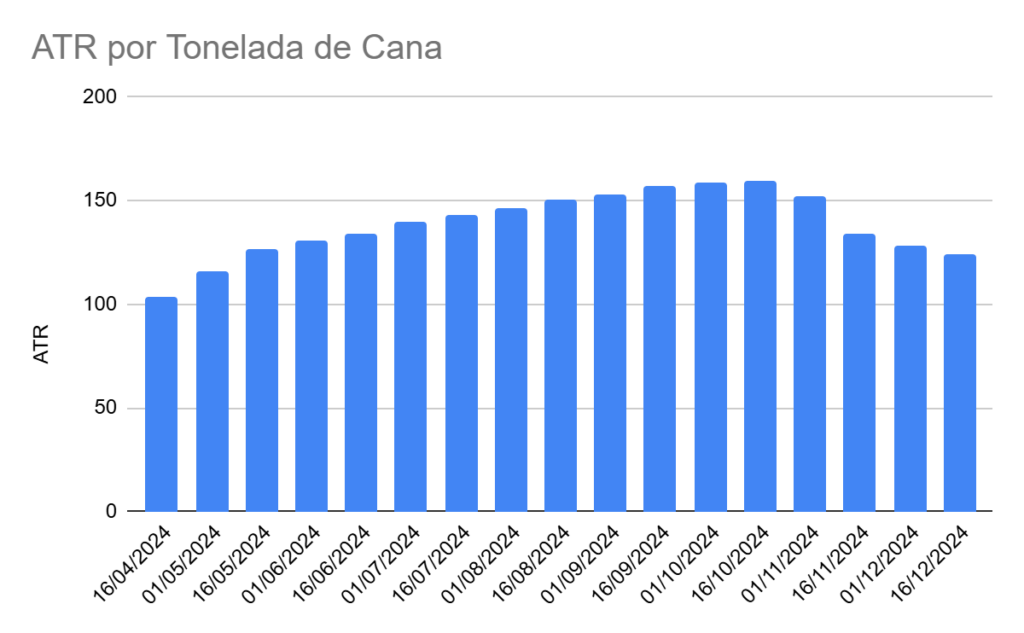
Sugarcane reaches peak productivity in September/October, with Total Recoverable Sugars (ATR) being the most commonly used indicator to measure its productivity. The table below shows the ATR figures for the entire 2024 harvest season, based on Única’s biweekly report.
As can be seen in the chart above, the ATR is lower at the start of the harvest season, peaks between September and October, and then falls again at the end of the harvest season.
The average ATR in the chart above is 138, the maximum is 160, and by the end of the harvest it drops to 123.
The ATR is a very important indicator for sugar mills, as it provides information on how much sugar or ethanol will be produced from 1 ton of crushed sugarcane.
And how does all of this relate to the industry's availability?
The sugar and ethanol industry must process the harvested sugarcane within 72 hours, because after that time the cane begins to rot, loses its sugar content, and becomes unsuitable for milling.
If critical equipment breaks down and brings the mill to a halt, it means that for a certain period of time, sugarcane will not be processed, and that automatically extends the harvest season for that mill—in other words, it increases the harvest size. For example, if a mill with a crushing capacity of 20,000 tons per day experiences a breakdown and is shut down for 12 hours, this means it failed to crush 10,000 tons during that period, and consequently, there will be 10,000 tons remaining to be crushed by the end of the harvest.
As we saw in the ATR chart, crushing sugarcane at the end of the harvest season is extremely detrimental to the company’s profitability, representing a 10% loss in profitability (when comparing the average ATR to the end-of-harvest ATR) and a 22% loss in profitability (when comparing the maximum ATR to the end-of-harvest ATR). In other words, this means that if this 12-hour shutdown occurred in June or July, the loss would be ~10%, and if the shutdown occurred in September or October, the loss would reach over 20%.
And what is the financial impact of all this?
Generally speaking, 1 kg of ATR yields ~0.90 kg of sugar and ~0.57 liters of ethanol.
The mills also produce a mix of sugar and ethanol; in other words, they cannot produce 100% sugar, so part of their processing is dedicated to sugar production and the rest to ethanol production.
Sugar sales are generally priced per 50-kg bag; as of March 2025, the average price is R$140.00 per 50-kg bag, and the price of ethanol is R$2.80 per liter.
In the example of the 12-hour shutdown, which resulted in a delay in processing 10,000 tons, assuming a production mix of 55% sugar and 45% ethanol, the mill’s estimated revenue, taking this change in ATR into account, would be:
- Revenue (maximum ATR) – R$1.625 million
- Revenue (average ATR) – R$1.409 million
- Revenue (final ATR for the harvest) – R$1.26 billion
Therefore, the financial impact of this unplanned shutdown amounts to a loss of revenue of approximately R$150,000.00 if we assume it occurred during months of normal productivity, and R$365,000.00 if we assume it occurred during months of peak productivity.
Avoiding a 12-hour shutdown throughout the entire harvest season through online vibration and temperature monitoring is a very low cost; on the other hand, the money that the mill would have otherwise lost in revenue covers the entire investment in our technology.