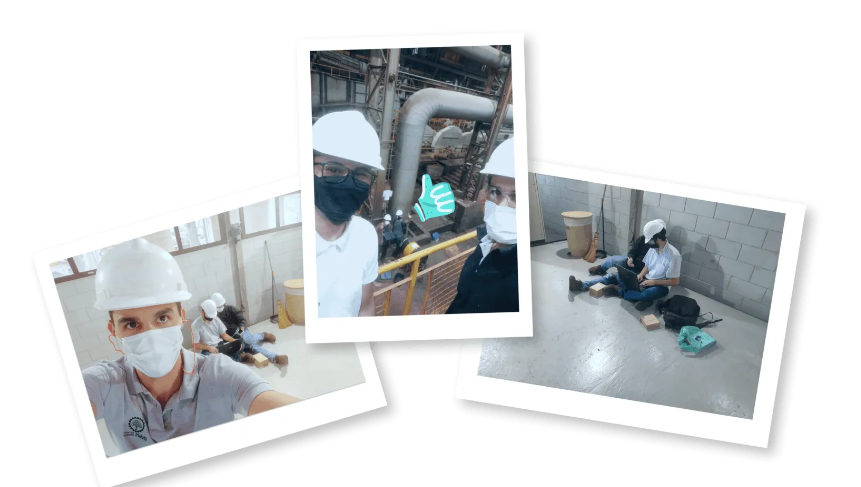
Our team worked hard on the sensors installed at plants like USL to improve the collection of vibration and temperature data. It was thanks to this dedication that the Tebe NXG has become even more accurate, a very important step in Tebe’s history.
In this article, you’ll learn what we’ve concluded about the areas where the Preditiva 4.0 system offers the best application and return on investment for power plants—a topic we’ve been studying since 2018 with the help of industry professionals.
Since this is a new technology that requires a natural adjustment period before it can be fully utilized, our smart sensors are initially installed on the plant’s most critical equipment.
We have compiled a list of the sectors, equipment, and number of points to be monitored first:
Where to install
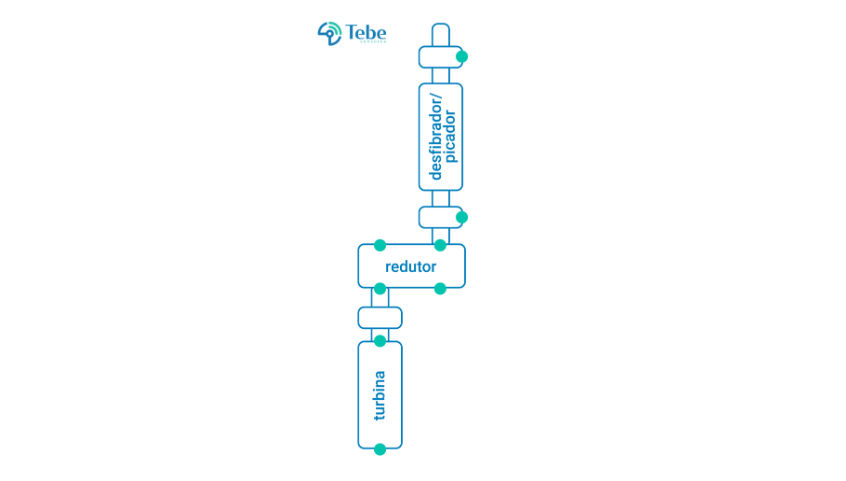
We recommend installing Tebe NXG sensors on the chipper and the shredder, which are essential pieces of equipment for the plant’s operation.
Suggested amount
8 sensors per set, including 2 on the turbine, 4 on the gearbox*, and one on each bearing of the shredder/chopper.
Where to install
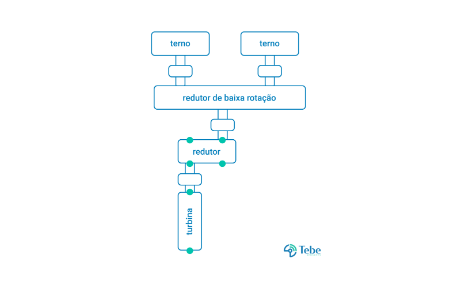
Whether your mill consists of turbines, gearboxes*, and flywheels, or is fully electrified, our sensor is essential in this industry.
Suggested amount
6 sensors per set, with 2 on the turbine and 4 on the gearbox*.
Power generation is a key factor in the plant’s revenue, as well as in the operation of all other equipment. Given the importance of this sector, monitoring the equipment is essential to ensure it operates in optimal condition.
Suggested amount
8 sensors per set, with 2 on the turbine, 4 on the gearbox*, and 2 more on the generator.
Key benefits
- Checking the alignment of assemblies: produce without the risk of operating with misaligned or improperly assembled equipment;
- Early detection of turbine imbalances : identify the failure in advance and plan the best time to perform turbine balancing;
- More detailed maintenance plan: Keep a record of vibration and temperature data from the beginning to the end of the harvest to assist with the equipment maintenance plan.
* On the gearbox, one sensor must be installed per bearing. Therefore, if the gearbox in question has 6 bearings, 6 sensors must be installed on the machine.