The Fourth Industrial Revolution has been a widely discussed topic in recent years, particularly with the emergence of new technologies, behaviors, and market trends.
As a result, many companies are looking for ways to keep pace with and adapt to these changes, especially in this new era of digitalization and automation. However, we know that not all companies have the financial resources to make a significant investment in technology.
If that’s the case for your company, this article is for you. Shall we move forward together toward the future of technology?
What is Industry 4.0?
Since this concept is still quite new, let’s start here. Industry 4.0 refers to the Fourth Industrial Revolution, which is defined by the integration of advanced digital technologies into the industrial production environment, with the aim of bringing greater efficiency, flexibility, adaptability, and cost reduction.
Broadly speaking, this term was coined to describe the major transformation that was already taking place within companies in the way they produced their goods and services.
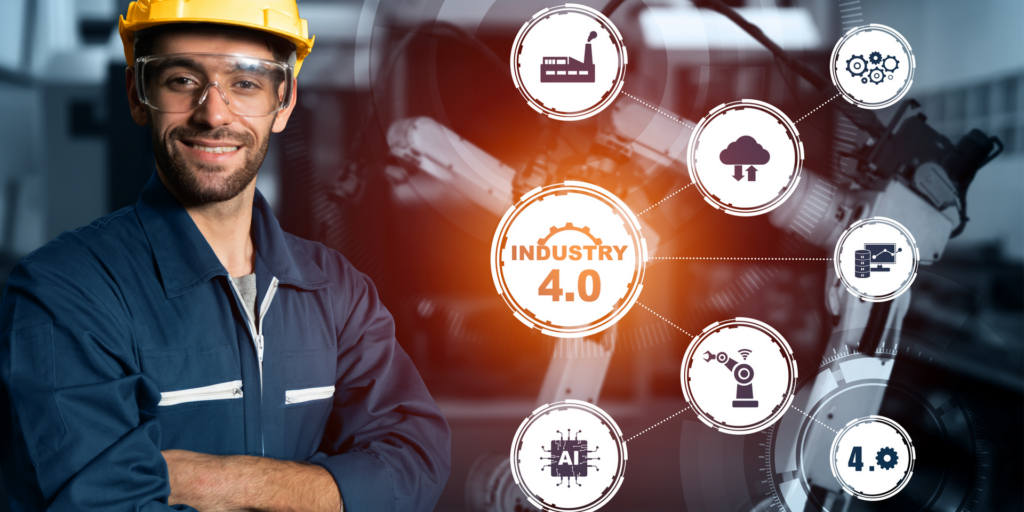
To illustrate this concept, we have listed below some of the key elements associated with Industry 4.0:
1. Internet of Things (IoT)
This technology involves connecting devices, machines, and systems to the internet, enabling real-time data collection and communication between different components in the production environment.
2. Cloud computing
Cloud computing enables the storage, processing, and access of data in a scalable and flexible manner, making it easier to manage the large volumes of information generated by production.
3. Big data and data analysis
The use of big data involves analyzing large datasets to extract valuable information, insights, and patterns that can guide decision-making in production.
4. Artificial Intelligence (AI) and machine learning
AI and machine learning systems are used to automate processes, predict failures, optimize production, and improve operational efficiency.
5. Additive manufacturing (3D printing)
It allows for the creation of parts and products layer by layer, offering greater flexibility in production and the ability to create complex designs.
Why doesn't it take a massive investment to implement Industry 4.0?
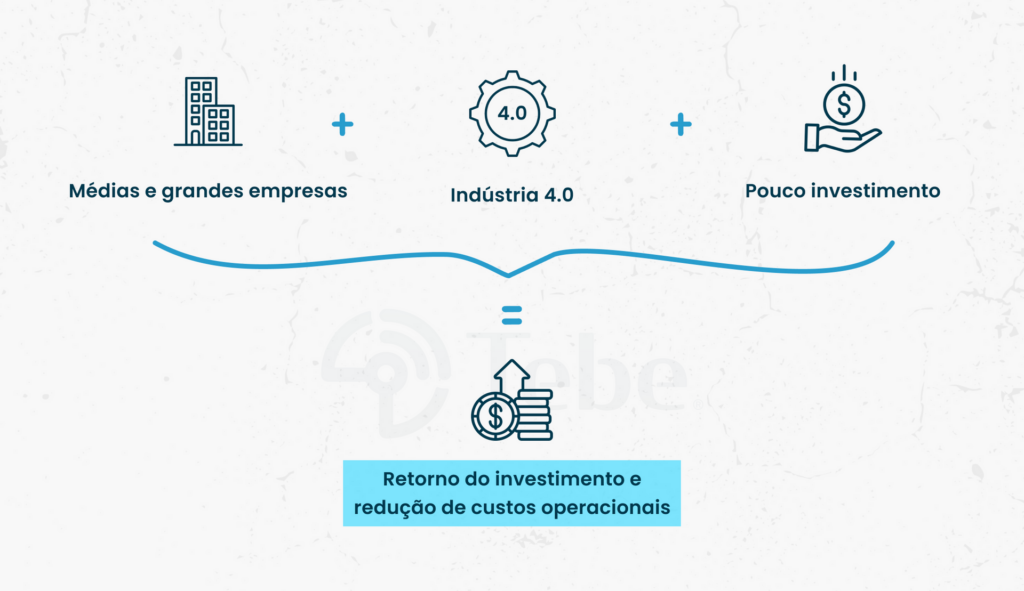
Nowadays, it is increasingly common to see companies adopting this concept and incorporating robots, devices, drones, and other technologies into their processes. By implementing these technologies and practices, medium and large companies are able to significantly reduce costs, achieving a return on investment far greater than the initial investment.
An important point to note is that the implementation of Industry 4.0 brings benefits that go beyond the financial aspect. It also has a positive impact on repetitive and exhausting tasks that were previously performed exclusively by humans but now rely on the assistance of technology.
It is important to note that technology is not here to replace the workforce, but rather to further train and support it, with the shared goal of ensuring the company’s financial health.
This, in turn, increases operational efficiency, self-management of the sectors, continuous improvements in workflows and modernization of business operations.
A survey conducted by the CNI (National Confederation of Industry) revealed that the majority of industries in the country (73%) use at least one digital technology in their operations. Although this is not yet the ideal figure, it indicates that we are moving in the right direction.
Many people think that Industry 4.0 involves the use of complicated and expensive tools, and that only large international companies can adopt this new production model.
If we look at it this way, we can conclude that companies need to make significant investments to adopt this technology and drive industrial innovation.
However, a pilot program called “Indústria Mais Avançada,” conducted by SENAI between May 2018 and October 2019 at 43 companies in 24 states, showed that the use of low-cost tools, such as sensing, cloud computing, and the Internet of Things (IoT), had a positive impact on market production.
This means that companies do not need to make expensive investments to achieve significant results with Industry 4.0.
The program also concluded that the increase in productivity is directly related to the ability to learn during the production process and to translate those lessons into concrete actions.
So, are you ready to embrace the future of Industry 4.0?
There are no more excuses or justifications—it’s time for your company to embrace Industry 4.0 within your budget, and we can help!
At the 3rd TEBE Talks, we were joined by Cleber Candido, CEO of Cesla, who shared three steps for implementing Industry 4.0 projects. Check out the full content here and learn where to start.
In addition, another way we can help your company embrace Industry 4.0 is by implementing remote monitoring and control systems.
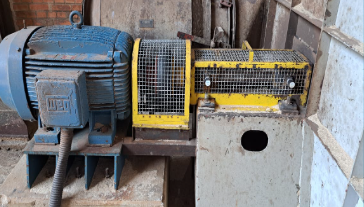
This is the case with our vibration sensor, which will help you identify defects before they become critical failures in your equipment.
Its advantages are numerous and cover a wide range of applications, particularly in industry, predictive maintenance, and machine monitoring. Below are some of the main ones:
- Early detection of problems
Vibration sensors can detect signs of anomalies and mechanical defects in machinery before these problems escalate. This enables early detection and proactive intervention.
- Reduction in maintenance costs
By anticipating failures and scheduling maintenance accordingly, the costs associated with corrective maintenance, unplanned downtime, and component replacement can be significantly reduced.
Early detection of mechanical problems allows the maintenance team to take action before significant damage occurs, helping to extend the equipment’s service life.
- Efficient asset management
Vibration sensors help with efficient asset management, allowing companies to prioritize equipment maintenance and replacement based on real-time data.
Overall, this type of technology allows you and your company to monitor your production processes in real time. This makes it possible to identify bottlenecks, optimize efficiency, and reduce operating costs without the need for major investments.